

Are we there yet?
The idiom of progress haunts politicians without purpose

Much was made last year of Keir Starmer’s ‘island of strangers’ speech. The prime minister was widely accused of channelling Enoch Powell. And leaving aside the political dimension, which I discussed in an earlier essay, this was true at the level of rhetoric. Starmer used an uncharacteristically arresting image. We all knew instantly what he meant. It is striking, though, that the positive image he counterposed to that negative one excited no comment. And perhaps deservedly. Starmer said, ‘we risk becoming an island of strangers, not a nation that walks forward together’. A nation that walks forward together. Not so much Enoch Powell, or even Neil Kinnock, as Chat GPT.
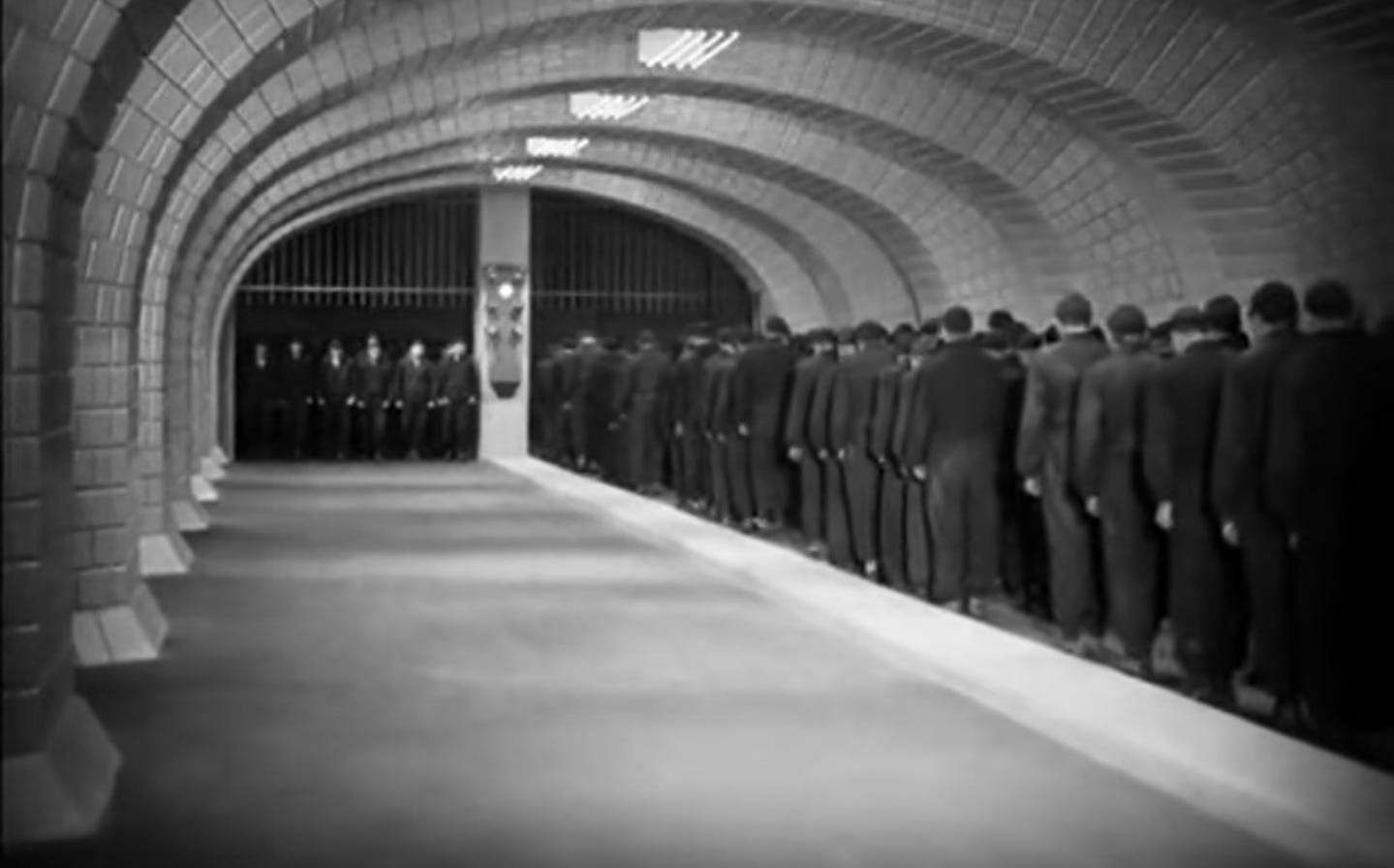
Nevertheless, Starmer’s instantly forgettable image is worth thinking about. Where are we supposed to be walking together? And why? What happens when we get there? Above all, how is it that such a bizarre image seems so unremarkable? The first thing to note is that we’re not really supposed to notice it at all. It’s just the kind of thing politicians say. It’s rhetorical furniture, like ‘communities up and down the country’ or even mere verbiage like ‘in any way, shape or form’. In the context of Starmer’s speech, it was little more than a verbal landing strip from the heady heights of ‘island of strangers’.
The second thing to note is that ‘walking forward together’ resonates (albeit weakly) with the wider idiom of progress. Politicians of all parties have spoken in this idiom for generations. They embrace change and look to the future. They refuse to wallow in nostalgia or turn back the clock. They promise to lead us, but not so much to any promised land, as to wherever we are already going. Forwards. Not back. Onwards to… the future!
Follow my leader
Indeed, it is the idiom of progress that requires politicians to be leaders. CS Lewis noticed in 1954 that ‘those who were once called a nation’s rulers are now almost universally called its leaders’ (1) and that, ‘Our demand upon them has changed no less than theirs on us. For of a ruler, one asks justice, incorruption, diligence, perhaps clemency; of a leader, dash, initiative, and (I suppose) what people call “magnetism” or “personality”’ (2).
Lewis was writing in the wake of the Second World War, during which leadership had obviously been at premium. But the first part of the twentieth century more generally had been a time of mass movements of left and right, led by charismatic leaders promising a brighter future. Let’s not forget that Adolf Hitler was ‘der Führer’.
In 1919, in the more immediate wake of the First World War, Max Weber gave a lecture to German students that was published as the now celebrated essay, ‘Politics as a vocation’ (3). In it, he identified the leader as a distinctive kind of politician, whose authority was based neither on tradition nor statute but on personal charisma (Lewis’ magnetism or personality). Noting that political rhetoric had devolved from an appeal to reason to the manipulation of apparent facts to mere emotivism, he said, ‘The existing situation can properly be described as a “dictatorship based on the exploitation of the emotional nature of the masses”’.
If this description seems to anticipate the rise of Hitler, Weber’s essay is as notable for what it did not anticipate. Namely, that, despite the carnage of the war to come, the twentieth century would see real progress, both materially and morally. The defeat of Nazi Germany, and the turn in the West against Soviet Russia, did not lead to a rejection of progress as a governing idea, nor diminish the demand for visionary leadership rather than merely just rule.
Instead, the war accelerated a tendency within the West to look to science and technology to transform society for the better. In the postwar period, there was also an increasing expectation of parallel improvement in social conditions, and even in morality and justice. In some cases, this was much needed. The US civil rights movement, for example.
Martin Luther King (despite having the last name of a ruler) was very much a charismatic leader, whose speeches certainly had emotional appeal. Few now would see that as a bad thing. While Weber invoked the biblical prophets in his discussion of leaders, though, it did not seem to occur to him that leaders might have genuine moral authority. To be fair, Weber also did not anticipate a ‘politician’ renouncing violence, which made King, in Weber’s terms, not a politician at all. Despite that, he led a movement that achieved genuine moral progress.
Perhaps, though, progress is the wrong way to think about it. ‘The arc of the moral universe is long,’ King said, ‘but it bends towards justice’. Justice, not progress. At least, not progress as an end in itself. Properly understood, progress implies a standard, a ‘rule’ against which to judge whether something amounts to progress or not.
There was nothing about the civil rights movement itself that compelled Americans (or anyone else) to ask, ‘what next?’. Whether gay rights, trans rights or any other claims have merit are questions to be resolved in terms of justice, not progress. The idea of progress as a neverending process of innovation in which novelty has value of its own is one borrowed from the world of science and technology. It is a mistake to apply it to morality (4).
Landing the promise
It is often said that the Martin Luther after whom King was named was an unwitting agent of progress. That he paved the way not only for an understanding of freedom of conscience he would not have endorsed, but for the secularisation of the West. History is far too complicated for such claims to be meaningful, but it’s certainly true that Luther himself was more concerned with justice than progress. The Protestant Reformation as a whole was supposed to be a correction, a return to the truth of the gospel, not a step forward into the unknown.
Martin Luther King also had a clear vision. A dream indeed. Like Moses leading the ancient Hebrews to the promised land, he knew exactly where he was leading his people, even if he only ever saw it from the mountaintop. (Now that is an arresting image.) It was the clarity of his vision that made King a great leader, albeit not a political leader in Weber’s more cynical sense. Real leadership implies a definite goal, not merely ‘walking forward together’.
What CS Lewis noticed, an ocean away and a year before King shot to prominence with the Montgomery bus boycott, was something different. The transformation of rulers into leaders even in peacetime Britain reflected the shift from a settled way of life to a growing consensus – an unspoken assumption, even – that society ought to be going somewhere.
It might be thought that Lewis objected to this because of his own fundamentally conservative temperament. Indeed, he seems to have been the kind of conservative who has no desire to be led because he has no particular desire to go anywhere. (Such a conservative might go out for the occasional stroll, but only so he can come home again, put on his slippers and light his pipe.) And perhaps that temperament blinded Lewis to the need for change. After all, it’s not as if postwar Britain had no room for improvement.
The 1942 Beveridge Report had identified five giants to be slain: want, disease, ignorance, squalor and idleness. Moreover, technological progress did hold out great promise to transform the country for the better. In 1963, Labour leader and soon to be Prime Minister Harold Wilson would call for a new Britain to be forged in the ‘white heat’ of the scientific revolution. Another arresting image. And these were not empty words, though Britain was remade less by any single, charismatic leader than by a generation committed to improvement. That generation is now much maligned, but – thanks to their leadership and hard work – Britons did in fact become healthier and wealthier.
Progress as a substitute for purpose
There is much to be said for true leadership in politics and civil society. Even on the cusp of genuine progress, though, Lewis’ misgivings about leaders replacing rulers were not merely reactionary. Like Weber before him, he saw that the qualities most often looked for in leaders were not – or not primarily – vision, determination and the ability to inspire others, but dash, initiative and magnetism or personality. Those qualities are all the more necessary – and their emptiness all the more apparent – in a politician without a vision, or indeed purpose.
Never mind that they are qualities Keir Starmer is criticised for lacking rather than praised for having; the point is they are still considered important, and perhaps all important. Notice instead that these qualities have little to do with actual leadership, the kind that takes people not merely ‘forward together’ but from one state or condition to a better one. Notice too that they are not moral qualities – like Lewis’ ideal ruler’s justice, incorruption, diligence and clemency – but practical ones. Useful for getting ahead in a certain kind of world. What kind?
It’s a world in which the future comes to us. In which leadership is not about deciding which direction to take, but identifying the direction of travel and getting ahead of the curve. As Kathleen Stock recently noted of the supreme example of this type of leader, ‘[Tony] Blair urges us to treat technology as a galloping horse we can only harness, not repel. This is how he always frames political decisions he finds exciting, as somehow outside the sphere of human decision-making altogether. European integration, globalisation, and now AI: such things are as inevitable as the weather’.
Blair used his personal charisma to transform the Labour Party and to lead a government that was in a sense the culmination of the postwar trend towards technocracy; government by ‘what works’. His faith in a future that would just keep coming – all based on an economy characterised by non-inflationary consistent expansion (NICE) – now seems quaint. The 1990s were like a faint echo of the postwar boom, so it’s unsurprising that they produced a political leader answering to Lewis’ description of one in the 1950s. The 2020s are very different. Starmer’s lack of personality is the least of our problems.
According to the 1662 Book of Common Prayer, the faithful are to beseech God to save the King, ‘that under him we may be godly and quietly governed’. Quiet please, Your Majesty. In 1662, people had had more than enough of inspiring leadership from kings or anyone else. Perhaps now is another time for quieter government, for something more like just rule than charismatic leadership. Perhaps it is time to retire the idiom of progress, at least from politics, to stop walking forward together and to enjoy being at home instead. When we’ve had a bit of a sit down, we might find there’s housework to be done.
1) Lewis, CS, English Literature in the Sixteenth Century Excluding Drama, 1954
2) Lewis, CS, De Descriptione Temporum, 1954
3) Weber, Max, The Vocation Lectures, 2004
4) For more on this, see ‘In praise of our moral inheritance’. For the interesting case of slavery, there’s a paragraph in ‘In praise of the aged’.